The Organisation of the Monastery
in the Early 19th Century
The monastery’s current layout is not only the result of the major changes made in the 1700s, but also of the work carried out after the Municipality of Cividale acquired the complex in 1812, when it was turned into a girls’ school.
A floor plan from that time allows us to understand how the spaces were arranged before the 19th‑century alterations. It shows a monastery organised in a practical and self‑sufficient way.
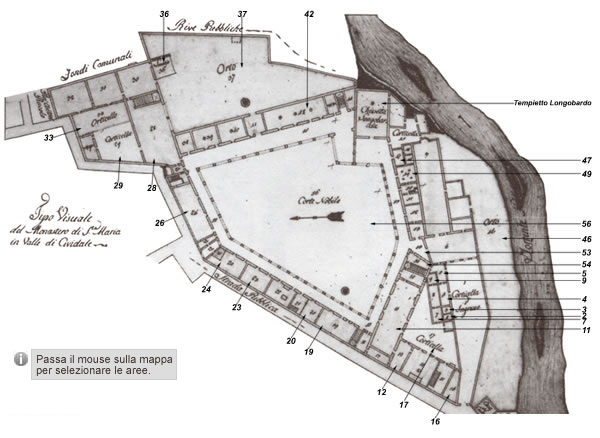
The wing facing Via Monastero Maggiore was used for day-to-day activities. Here were the kitchen and related rooms, such as the pantry (12), the henhouse (16), the oven room (19), the stove room (20), the wood store (23–24), the cellar (26), and a space used to store empty barrels (28). A small courtyard was used for keeping pigs (29), while a small vegetable garden (33) and the laundry rooms (36) were located near the entrance to the underground laundry area (36).
The kitchen was directly connected to the refectory (11) and to a small courtyard (17), which served as a link to the areas used for contact with the outside world: small rooms used as a writing room and parlour (2–3–4–5–7–9).
Near the Church of San Giovanni is the entrance to the monastery (53), fitted with a rotating device that allowed items to be passed into and out of a cloister without visual or verbal contact, and a parlour where the portresses could speak with visitors (54). On the north side of the church were the small choir and the confessional (47), a room with four columns used either as a wardrobe or as the Holy Communion room (49), and a small service room.
Outside, the vegetable garden with a well (37) was separated from the main courtyard, which housed the cloister (56), by a colonnaded building, part of which served as a large cellar (42). The other large garden (46) was also used for growing vegetables.
On the first floor, there were numerous small rooms and bedrooms; the novitiate in the south-west corner overlooking Via Monastero Maggiore (complete with its own kitchen); the refectory for the sick; the infirmary, and the large rooms used by servants and nuns.
The attic floor was used as a granary.